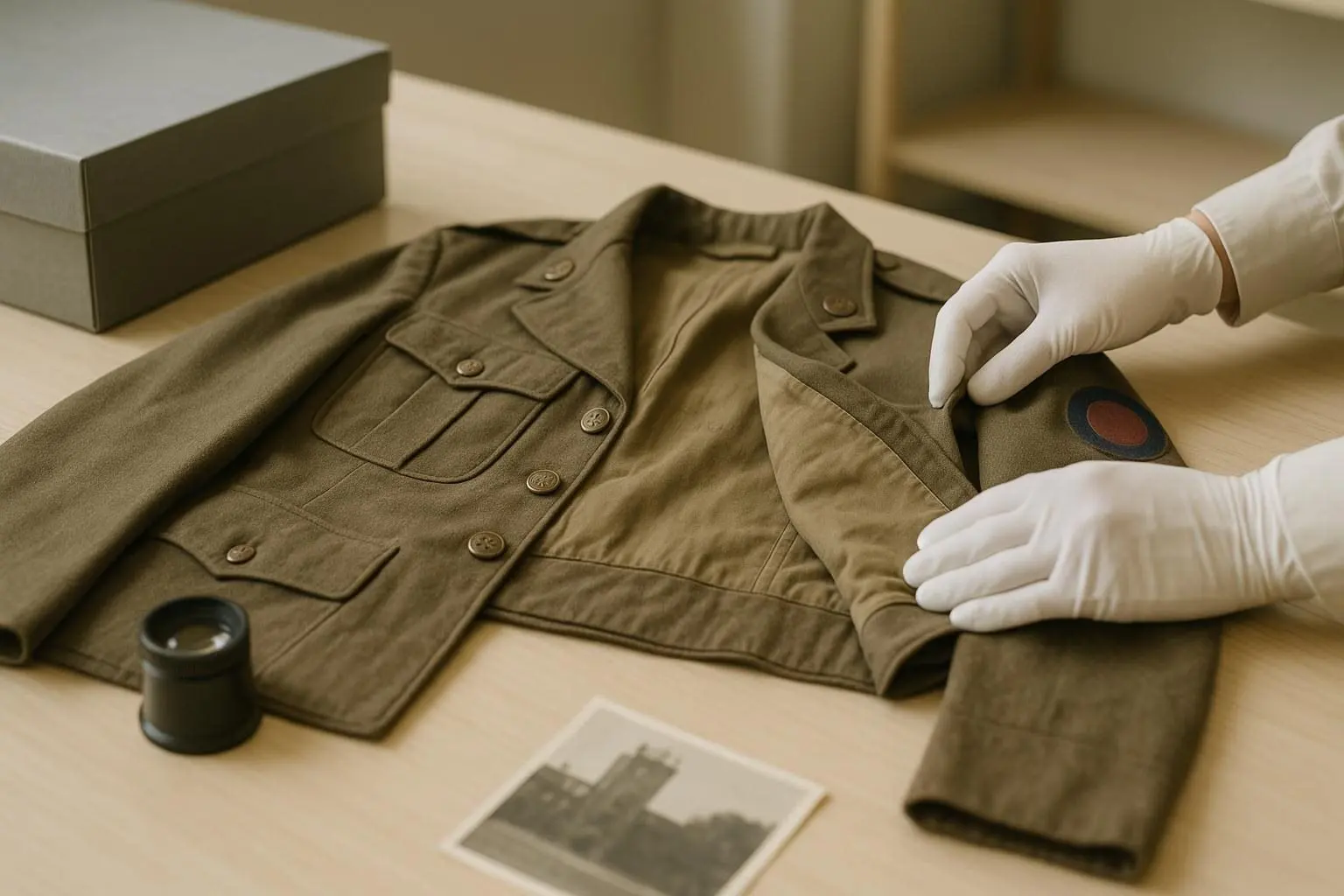
A museum volunteer opens a small archival box and finds a service photograph, a telegram, and a paper label written in a relative's hand. None looks dramatic. Together, they may establish where someone served, how a family learned of a death, and what was remembered-or left unsaid-after the conflict.
That is the distinctive work of local history collections. They do not replace national archives or major military museums. They preserve ordinary evidence broader institutions may never have gathered: personal artifacts, family photographs, workplace records, school memorials, and testimony tied to a street, parish, regiment, port, or town.
The archive moved closer to everyday life
Military history was long organized around commanders, campaigns, weapons, and official decisions. Those subjects remain essential, but they leave gaps. A government file may record a unit's movement without showing how a household coped with an absent parent, how a wounded veteran found work, or why a family kept one unremarkable button for decades.
The expansion of public history brought greater attention to these contexts. Local museums, historical societies, libraries, veterans' groups, and community archives began treating domestic records as evidence rather than sentimental leftovers. A postcard can reveal censorship and family language; a ration book, the limits of civilian life; a school photograph, the community surrounding a future service member.
The important question is not whether an object looks impressive, but whether it helps answer a documented question about people, institutions, or memory.
Provenance became part of the object
A helmet, medal, or letter is not self-explanatory. Its meaning depends on provenance: who owned it, when it was used, how it passed through a family, and what evidence supports the account. Local collections are well placed to preserve this chain because donors often bring names, relationships, captions, and stories that might otherwise disappear.
Those details require careful recording, without treating family memory as unquestioned fact. A handwritten note may identify someone, while a service record, newspaper report, or dated photograph may confirm or complicate the claim. Conflicting accounts can reveal how memory changed, how trauma affected recollection, or how later generations interpreted an ambiguous past.
Good cataloguing separates what is known from what is believed, records the source of each assertion, preserves useful original wording, and allows revision when new evidence appears. This protects historical accuracy and the donor's dignity.
The ordinary object gained evidentiary weight
A broader understanding of material culture made rarity, monetary value, and fame less important. An object's wear, alterations, repairs, and storage may be as informative as its original purpose.
A uniform repaired at the elbow can suggest extended use, but cannot prove who wore it or where. A diary with missing pages may indicate privacy, later editing, or simple damage. A photograph's reverse may contain dates, names, or a studio mark. Packaging, envelopes, and accession notes can preserve an object's path from a wartime setting into a family collection.
Preservation requires restraint. Cleaning can erase residue, ink, or surface evidence; flattening a folded document can damage it; separating an object from its label can destroy context no database can fully restore. Conservation should follow qualified professional advice and current institutional standards, which may change as methods and regulations develop.
Community archives made absence visible
Local collections also changed the questions museums ask. When archives seek material from civilians, minority communities, displaced people, medical workers, industrial employees, and former enemies, history becomes less dependent on official power.
Absence can be evidence, but it must be interpreted cautiously. A collection dominated by military paperwork may reflect what institutions preserved, not whose experiences mattered most. Missing letters may result from censorship, poverty, displacement, illiteracy, or destroyed homes-not a lack of feeling or participation.
Community archiving can address these gaps through oral histories, digitized family albums, local newspapers, and open calls for documentation. It works best when contributors retain a voice in how their material is described and displayed. Public history is not simply expert knowledge delivered to an audience; it involves ownership, language, privacy, and memory.
Digital access changed discovery, not preservation
Scanning and online catalogues make dispersed collections easier to find, compare, and research. A family photograph may illuminate a name in a town memorial register; a newspaper may clarify a letter's date. Digital access can reconnect fragments separated by geography and generations.
A scan, however, is not the original. It may omit thickness, stitching, paper quality, scale, odor, or marks visible only through careful examination. Metadata can also turn an uncertain identification into apparent fact. Digital records should distinguish transcription from interpretation and, where possible, identify the information's source.
Privacy requires equal care. Names, addresses, medical details, and wartime experiences may affect living relatives. Institutions should follow their ethical policies and current legal requirements, recognizing that privacy, copyright, repatriation, and export rules vary by jurisdiction and may change. Public access is valuable, but it is not automatically unrestricted access.
Preservation begins with a better question
The strongest local collections do more than accumulate objects. They preserve relationships among objects, people, places, and testimony. Before accepting or displaying material, a curator or community archivist should ask: What is the proven chain of ownership? What claim can the object support? What context would be lost if it were separated from its papers? Who might be harmed by publication? What uncertainty must remain visible?
These questions turn a keepsake into evidence without stripping it of emotional meaning. They also prevent a common mistake in military history: treating the human story as decoration around the operational account. A letter, photograph, or repaired garment can show how conflict entered a home, altered a neighborhood, and continued in memory after the official campaign ended.
That is why modest local collections matter. Their greatest contribution is often not a spectacular artifact, but a carefully preserved connection between a name and a life.


Leave a Reply